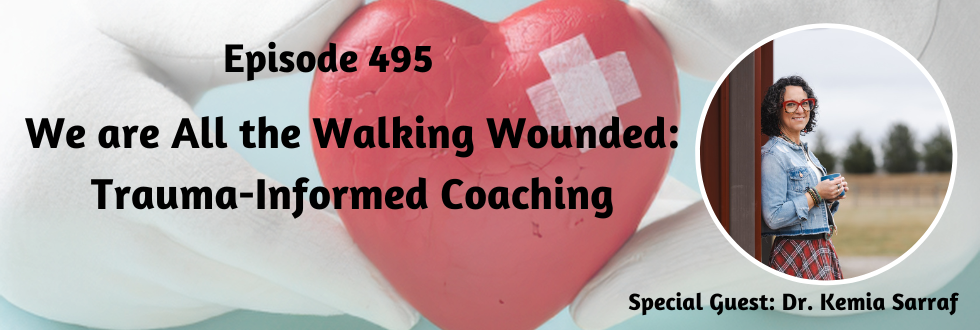
I’m thrilled to welcome back a previous guest today! Her first appearance was in Episode 232 back in 2020. She helps us get clear on something that confuses many coaches: What does it mean to be “trauma-informed,” and why does it matter for every single one of our clients? We will uncover the neuroscience, practical moves, and the truth about what’s happening in the nervous systems of the people we coach. We take a closer look at the difference between coaching and therapy, why there is always an overlap, and where the dividing line lies between big emotions, coaching, and therapy. Join us!
Dr. Kemia Sarrah, “Dr. K”, is an internist, educator, physician, and leadership coach. Her subspecialty is a focus on leadership and coaching in and beyond severe burnout, toxic stress, and trauma. She is the founder and CEO of Lodestar, a professional coaching and consulting firm that utilizes a 360-degree trauma-aware container for coaching, coach training, leadership training, and Justice, Equity, Diversity & Inclusion facilitation. Her medical degree and Master of Public Health are from the University of Utah School of Medicine, and she currently serves as an Adjunct Assistant Professor at Southern Illinois University School of Medicine in the Office of Equity, Diversity & Inclusion. Dr. K is a gifted storyteller and sought-after speaker with a deeply intuitive communication style, and her trademarked coaching paradigm has a lens focused on the secondary trauma that is part of daily life for high-achieving, hard-driving, and highly skilled professionals across various industries. Blending extensive experience with balance, humor, and endless empathy, Dr. K has helped countless physicians and professionals rediscover their professional pride, joy, and internal balance. She lives with her physician-husband on a small, working farm in Central Illinois, where they are raising four sons and too many farm critters to count.
Show Highlights:
- The question at the crux of it all: How can coaching and trauma co-exist in the same work?
- All Lodestar programs are dual-accredited by the ICF and the ACCME, meeting the rigorous standards for both coaching and medical education.
- Understanding the overlaps and distinctions between coaching and therapy
- Positioning yourself as a coach who is trauma-informed and trauma-responsive, being a “skilled holder” of what the client brings into the conversation
- Laying the foundation of the coach/client relationship in the beginning
- Trauma: more than events in time, but exposure over time (“The dose makes the poison.”)
- Understanding stress (not always a bad thing!), its effects, like loneliness and uncertainty, and long-term stress exposure
- The neuroscience of the “unsafe” brain: It cannot update its predictions, learns the wrong things, and cannot differentiate between predator threats and social threats.
- Recognizing the path forward with our clients: The stories our nervous system tells follow the state of our nervous system as a whole.
- “We are all the walking wounded. What you are experiencing is very real.”
- The key message from Dr. K: “Coaches are uniquely pre-set to do this exceedingly well. The beauty of this skillset is that it’s rooted in the similarities of our nervous system; these skills are universally teachable, learnable, and applicable.”
Resources:
Connect with Dr. Kemia Sarraf
Website, Facebook, and SCS Episode 232
Connect with Meg
Explore the STaR Coach Show Mentor Program. We are enrolling NOW for this fall!
Join the STaR Coach Community. Become a member today!
Subscribe to the STaR Coach Show YouTube Channel!Explore over 480 past episodes and other helpful resources at www.STaRcoachshow.com.